---
layout:
title:
visible: true
description:
visible: false
tableOfContents:
visible: true
outline:
visible: true
pagination:
visible: true
---
# Channels
In the modern world of e-commerce, your website is no longer the only point of sale for your goods.
The **Channel** model represents a single sales channel, which can be one of the following things:
* Webstore
* Mobile application
* Cashier in your physical store
Or pretty much any other channel type you can imagine.
**What may differ between channels?** Particularly anything from your shop configuration:
* products,
* currencies,
* locales (language),
* countries,
* themes,
* hostnames,
* taxes,
* payment and shipping methods,
* menu.
A **Channel** has a `code`, a `name` and a `color`.
To make the system more convenient for the administrator, there is just one, shared admin panel. Users are also shared among the channels.
{% hint style="info" %}
In the dev environment, you can easily check what channel you are currently on in the Symfony debug toolbar.\
\

{% endhint %}
### Different menu root
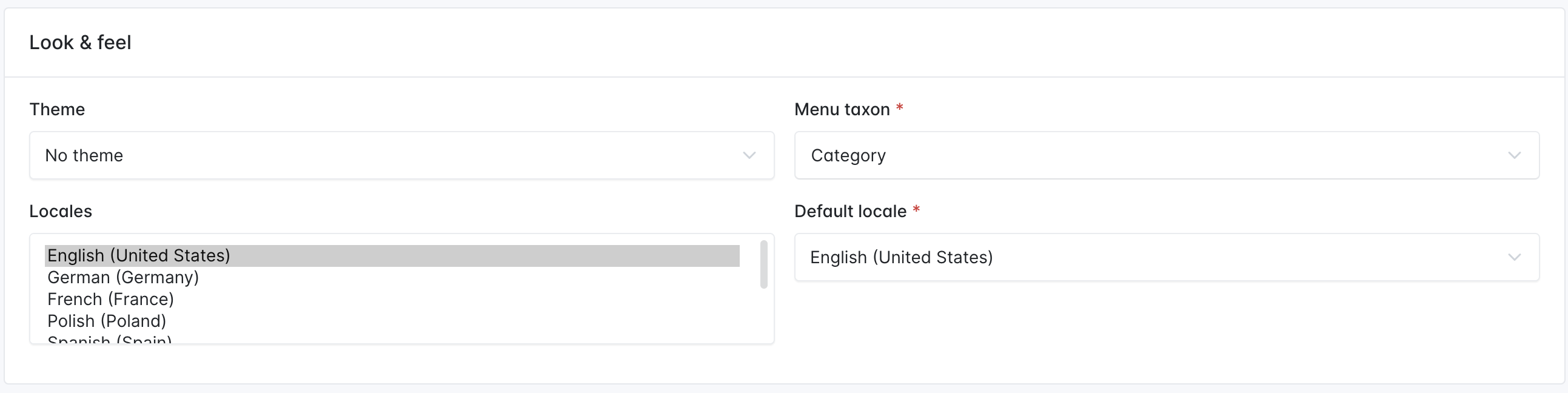
By default, Sylius will render the same menu for all channels defined in the store, which will be all the children of the taxon with the code _category_. You can customize this behavior by specifying a menu taxon in the “Look & feel” section of the desired channel.
With this configuration, this particular channel will expose a menu starting from the children of the chosen taxon (T-Shirt taxon in this example):
The rest of the channels will still render only children of _category_ taxon.
**How to get the current channel?**
You can get the current channel from the channel context.
```php
$channel = $this->container->get('sylius.context.channel')->getChannel();
```
{% hint style="danger" %}
Beware! When using multiple channels, remember to configure `hostname` for **each** of them. If missing, the default context will not be able to provide an appropriate channel, resulting in an error.
{% endhint %}
{% hint style="info" %}
The channel is by default determined based on the hostname, but you can customize that behavior. To do that you have to implement the `Sylius\Component\Channel\Context\ChannelContextInterface` and register it as a service under the `sylius.context.channel` tag. You should also add a `priority="64"` since the default ChannelContext has a `priority="0"` (and by default a `priority="0"` is assigned).
{% endhint %}
{% hint style="info" %}
Moreover, if the channel depends mainly on the request you can implement the `Sylius\Component\Channel\Context\RequestBased\RequestResolverInterface` with its `findChannel(Request $request)` method and register it under the `sylius.context.channel.request_based.resolver` tag.
{% endhint %}
### Shop Billing Data
For [Invoicing](https://docs.sylius.com/en/1.13/book/orders/invoices.html) and [Credit Memo](https://docs.sylius.com/en/1.13/book/orders/refunds.html) purposes Channels are supplied with a section named Shop Billing Data, which is editable on the Channel create/update form.
{% embed url="https://sylius.com/plus/?utm_campaign=plus&utm_medium=cta&utm_source=docs" fullWidth="true" %}
#### Business Units
Sylius Plus is supplied with an enhanced version of Shop Billing Data from Sylius CE. It is also used for Invoicing and Refunds purposes. Still, it is a separate entity, that you can create outside of the Channel and then pick a previously created Business Unit on the Channel form.